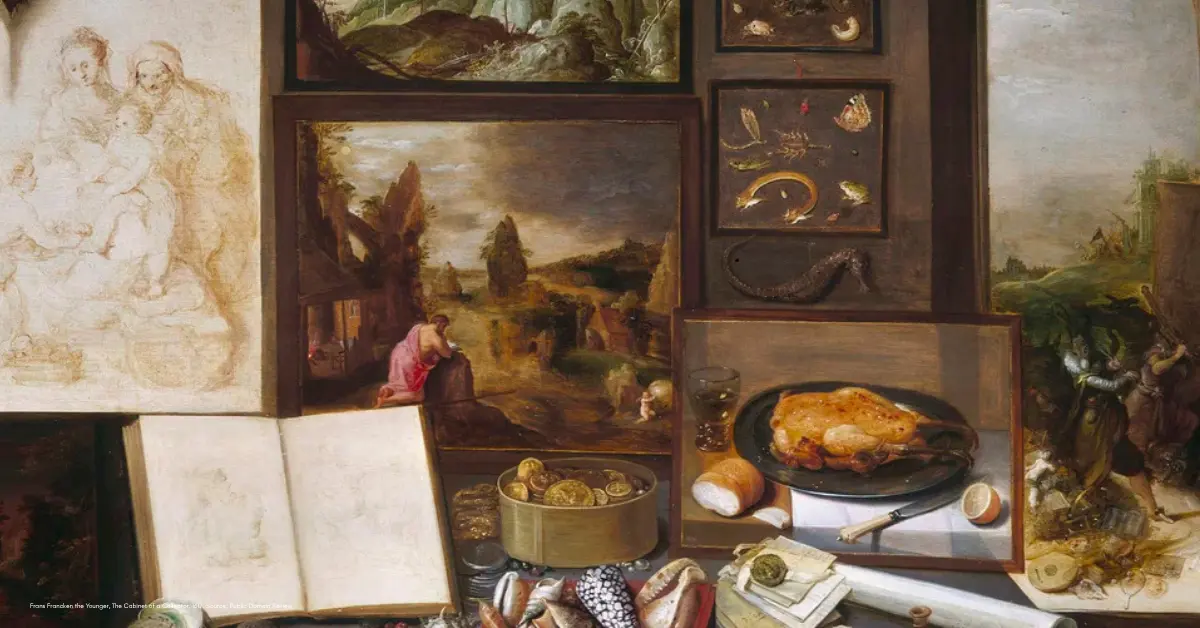
A collector once described her approach as "buying what I love and figuring out the theme later." Ten years and several hundred objects on, she still hasn't found one. What she has is a storage unit.
This isn't a cautionary tale about taste. She loves everything in that unit, individually, sincerely. The problem is that a pile of things you love isn't automatically a collection. A collection is a pile of things you love that also talk to each other.
Most people who start collecting begin the same way: something catches their eye, they buy it, they enjoy it, they buy the next thing that catches their eye. This is a perfectly reasonable way to accumulate objects. It is a much less reliable way to build something that holds together, appreciates in meaning as well as value, or says anything coherent about the person who assembled it.
The distinction curators make, almost instinctively, is between acquisition and curation. Acquisition asks whether a single object is good. Curation asks whether it belongs, and what it does in relation to everything around it. A world-class painting can be a poor acquisition for a specific collection if it has nothing to say to the other forty works already on the wall.
This is not an argument against buying what you love. It's an argument for eventually asking why you love it, and whether that "why" points somewhere.
A collecting thesis isn't a rigid rulebook or a marketing pitch. At its simplest, it's a sentence a collector can say out loud that explains what the collection is actually about: a period, a question, a region, a material, an argument. "Postwar abstraction by artists who never got their due." "Scientific instruments from the century before mass production made craftsmanship optional." "Photography that documents labor rather than leisure."
None of these are especially narrow. They're specific enough to make decisions easier, not harder. A thesis doesn't shrink the collector's options; it gives them a filter for the thousands of objects that will never fit and a reason to move quickly on the handful that do.
It also does something less obvious: it turns a collection into a body of evidence. A single rare object is a curiosity. Forty objects assembled around a coherent idea become an argument, and arguments are what scholars, museums, and future generations actually want to study. Provenance research, loan requests, and eventual donations all become dramatically easier when a collection has a discernible logic rather than a discernible price tag.
Ask any serious collector what defines their collection, and eventually the conversation turns to what they passed on. Declining a genuinely excellent object because it doesn't serve the collection's logic is, in practice, the harder skill; buying well is comparatively easy once the thesis is clear.
This is where advisors, curators, and dealers who understand a collector's thesis become more valuable than a general market scan ever could. A dealer with no visibility into the underlying logic will show a collector whatever is currently for sale. A dealer who understands the thesis will recognize when something outside the obvious channels actually fits, and just as importantly, will say nothing when it doesn't.
The discipline compounds. Each object acquired with a thesis in mind makes the next decision faster, because the collector isn't reasoning from scratch each time; they're checking a new candidate against an argument they've already made. Collectors without a thesis tend to relitigate the same basic questions with every purchase. Collectors with one are usually deciding on details.
The fear collectors sometimes voice is that a thesis will make the process rigid, or worse, boring: a checklist instead of a pursuit. In practice the opposite tends to be true. A clear thesis makes room for genuine surprise, because the collector can recognize immediately when an unexpected object actually deepens the argument rather than distracting from it.
Some of the most interesting collections in institutional hands today didn't start out looking coherent at all. They became coherent because the collector kept asking, patiently and over years, what the objects had in common and what story they were trying to tell. Coherence, in other words, doesn't have to arrive first. It has to arrive eventually, and it has to be something the collector can articulate, not something a cataloguer invents after the fact to make an estate sale easier to describe.
A collection built around a thesis tends to have a longer life than one built around impulse, and not only because it's more satisfying to live with. Museums are far more likely to accept a coherent, well-documented body of work as a gift or bequest than a scattered assortment, however individually valuable. Scholars are more likely to request access to a collection that represents a clear body of evidence. And the collector's own descendants are considerably more likely to keep, rather than liquidate, something that reads as a deliberate act of stewardship rather than an expensive habit.
None of this requires grand ambition. A thesis can be modest, personal, even private. What it requires is the willingness to ask, periodically and honestly, what the collection is actually for, and enough discipline to let that answer say no as often as it says yes.
About Orpheus
Orpheus Alerts helps collectors track down specific, rare, and hard-to-find objects across the categories they care about most, combining broad market monitoring with the kind of discreet, specialist-led research that a well-defined collecting thesis deserves. Orpheus Alerts — When you know what you want.
