The Orpheus Record Room is a guide to the watches that have achieved the highest publicly reported sale prices – not simply because they were expensive, but because they carried the signals serious collectors search for: rarity, provenance, complication, original condition, cultural importance, ownership history, charity context, and timing.
At the top of the watch market, value is rarely created by brand alone. A Patek Philippe is not valuable simply because it is a Patek Philippe. A Rolex Daytona is not historic simply because it is a Daytona. The watches that define the market are the ones where the story becomes impossible to separate from the object. A unique stainless-steel grand complication. A banker’s impossible pocket watch. A Hollywood icon’s personal chronograph. A steel perpetual calendar chronograph. A one-off independent masterpiece. A double-signed world time.
A watch that exists because a collector, maker, charity, or moment made it unrepeatable.
These are the signals Orpheus Watch Alerts is built to understand.
Sold for CHF 31,000,000 – Only Watch / Christie’s, Geneva, 2019
The Patek Philippe Grandmaster Chime Ref. 6300A-010 remains the most expensive watch ever sold publicly. Created specially for Only Watch 2019, it was the first and only Grandmaster Chime produced in stainless steel, a material that carries special significance in Patek collecting precisely because the manufacture’s most complicated watches are usually cased in precious metals. Christie’s describes the watch as the first and only stainless-steel version of the reference, while contemporary auction coverage noted its reversible case, two dials, and 20 complications.
The result was not just a triumph of complication. It was the convergence of everything collectors respond to: a unique configuration, the most important modern Patek complication, a charity auction, steel rarity, and the knowledge that the watch would never be repeated. A conventional search might identify it as another Grandmaster Chime. A serious collector understands that the “A” in the reference – acier, or steel – changes everything.
Sold for approximately $24,000,000 – Sotheby’s, Geneva, 2014
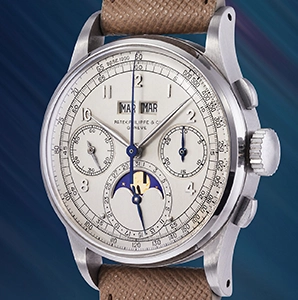
The Henry Graves Supercomplication is the great pocket-watch legend. Commissioned by American banker Henry Graves Jr., it was built during an era when wealthy patrons competed to commission increasingly complex timepieces. When it sold at Sotheby’s Geneva in 2014 for 23.2 million Swiss francs, approximately $24 million, it reclaimed its place as the most valuable timepiece ever sold at the time.
Its story is powerful because it belongs to the pre-digital age of mechanical ambition. This was not a modern limited edition created for spectacle. It was a patron-driven masterpiece produced to stretch the boundaries of what could be done by hand, with gears, springs, charts, astronomical indications, and human skill. For Orpheus, it represents one of the most important search signals in all collecting: commission history. A watch made for someone specific can become more important than the same object made anonymously.
Sold for $17,752,500 – Phillips, New York, 2017
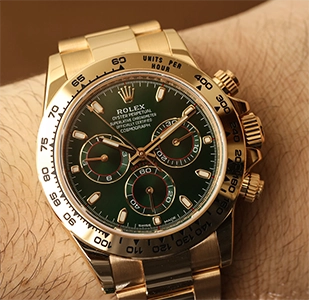
Paul Newman’s personal Rolex Daytona Ref. 6239 changed the public perception of vintage Rolex forever. The watch was gifted to Newman by his wife Joanne Woodward and famously engraved on the back with the words “Drive Carefully Me.” It later passed to James Cox, then the boyfriend of Newman’s daughter, before coming to auction in 2017. Its $17.8 million result made it the most expensive wristwatch ever sold publicly at the time.
This is the perfect example of provenance overtaking specification. The exotic-dial Daytona was already one of the great vintage Rolex references, but this was the watch that gave the nickname “Paul Newman” its cultural force. The value was not merely in the dial. It was in the wrist, the photographs, the racing mythology, the gift, the engraving, and the chain of ownership. One watch transformed an entire collecting category.
Sold for CHF 15,700,000 / approximately $17,300,000 – Only Watch, Geneva, 2024
The Patek Philippe Ref. 6301A was the headline lot of Only Watch 2024, selling for CHF 15.7 million, approximately $17.3 million. The watch was a unique steel grande and petite sonnerie minute repeater with a hand-guilloché Grand Feu enamel dial, and the sale represented more than half of the total funds raised by that year’s auction.
This watch is important because it shows that the Only Watch formula remains powerful when the right object appears: unique, complicated, steel, Patek Philippe, charitable, and visually distinctive. It also shows that collectors respond not only to vintage scarcity, but to modern singularity. A watch does not need decades of ownership history if its creation story is already unrepeatable.
Sold for $13,922,000 – Phillips, New York, 2026
In June 2026, Phillips reported a $13.9 million result for an F.P. Journe Souscription Résonance, describing it as an industry-leading achievement for both the brand and independent watchmaking.
The result matters because it signals the arrival of independent watchmaking at the very highest level of public auction value. F.P. Journe collectors do not simply search by model name. They search by era, brass-movement period, subscription status, case metal, dial configuration, provenance, and production context. The Résonance is especially powerful because it combines a distinctive technical idea with the mythology of early Journe collecting. For Orpheus, this is precisely the kind of market where search intelligence matters: small production, nuanced terminology, and very fast-moving demand.
Sold for $10,755,000 – Phillips, New York, 2025
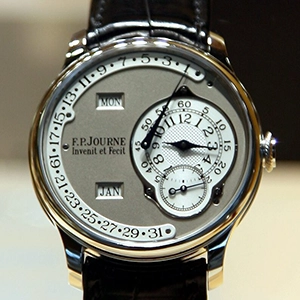
Francis Ford Coppola’s F.P. Journe FFC Prototype sold at Phillips in New York for $10.755 million in 2025. The watch was a collaboration between Coppola and F.P. Journe, using an articulated hand display inspired by a conversation between the filmmaker and the watchmaker.
This sale is remarkable because it merged independent horology with cultural provenance. It was not simply “an F.P. Journe.” It was Coppola’s personal example, born from a creative exchange between a legendary filmmaker and one of modern watchmaking’s most important independents. That combination – named owner, prototype status, unusual display, maker significance – created a record-level object.
Sold for HK$70,175,000 / just under $9,000,000 – Christie’s, Hong Kong, 2019
The Patek Philippe Ref. 2523 “Gobbi Milano” world time sold at Christie’s Hong Kong for HK$70,175,000, just under $9 million, making it the most expensive wristwatch ever auctioned in Asia at the time. The watch combined a pink-gold case, blue enamel dial, world-time complication, and double signature from Milan retailer Gobbi.
The value here sits in the overlap between complication, dial, retailer signature, and regional collecting power. A world-time Patek is already special. A blue enamel world-time Patek is rarer. A double-signed Gobbi Milano example adds another layer of desirability. For Orpheus, this is a classic reminder that a small phrase in a listing – “double signed” – can completely change the significance of a watch.
Sold for CHF 7,300,000 – Only Watch, Geneva, 2015
The Patek Philippe Ref. 5016A sold at Only Watch 2015 for CHF 7.3 million, at the time becoming the most expensive wristwatch ever sold at auction. The watch was a unique stainless-steel version of a highly complicated Patek reference, combining a minute repeater, tourbillon, and perpetual calendar.
Its importance lies in the template it helped establish. Patek Philippe, steel, unique, charity, grand complication: that combination has become one of the most powerful formulas in modern watch auctions. The Ref. 5016A also shows how Only Watch can create objects that collectors know will never appear again in the same form.
Sold for $6,503,500 – Phillips, New York, 2021
The Tiffany Blue Patek Philippe Nautilus Ref. 5711/1A-018 sold at Phillips New York for $6,503,500 in 2021. The watch was one of 170 pieces created to celebrate the 170-year relationship between Patek Philippe and Tiffany & Co., and the first example offered publicly became a major cultural event within modern watch collecting.
This sale reveals the power of modern hype when it is attached to legitimate scarcity. The Nautilus was already the defining steel sports watch of its era. The Tiffany dial added color, co-branding, allocation mystery, and cultural heat. For Orpheus, this is the kind of watch where an alert cannot simply search “Nautilus.” It must understand reference number, dial color, retailer signature, production context, and the difference between ordinary demand and a market moment.
Sold for CHF 6,200,000 – Only Watch, Geneva, 2017
The Patek Philippe Ref. 5208T sold at Only Watch 2017 for CHF 6.2 million. It was a unique titanium grand complication, and its sale demonstrated again that Patek’s Only Watch pieces could command enormous premiums when they combined rarity, complication, and an unusual case material.
The Ref. 5208T matters because titanium is not the expected material for this type of Patek Philippe grand complication. Collectors respond to that tension: a highly traditional manufacture using a modern technical metal for a one-off charitable object. In auction language, “unique titanium Patek grand complication” is not a description. It is a signal flare.
Sold for $5,900,000 — Phillips, Geneva, 2018
The Rolex Daytona Ref. 6265 known as “The Unicorn” sold for $5.9 million at Phillips in 2018, becoming the second-most expensive Rolex publicly auctioned at the time. The nickname came from the belief that it was the only known vintage manual-wind Daytona in white gold.
The Unicorn is valuable because it breaks the normal taxonomy. Vintage Daytonas are overwhelmingly steel, with some yellow-gold examples. A white-gold manually wound Daytona is therefore an anomaly. In collector markets, anomalies matter. The search signal is not just “Daytona 6265.” It is “white gold,” “unique,” “possibly one-off,” “private collection,” and “Daytona Ultimatum.”
