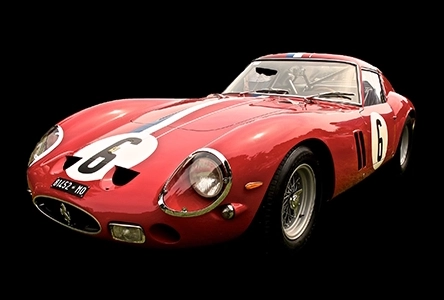
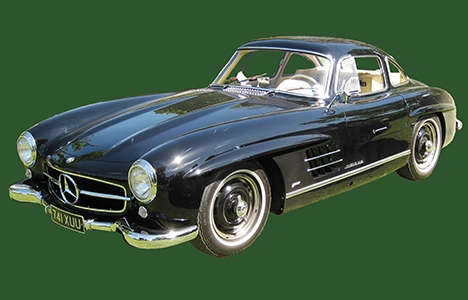
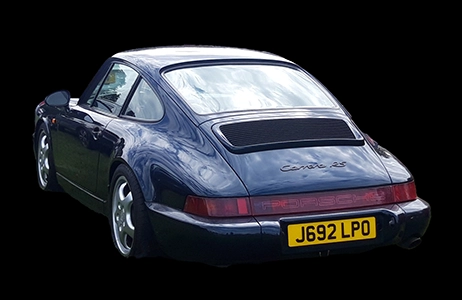
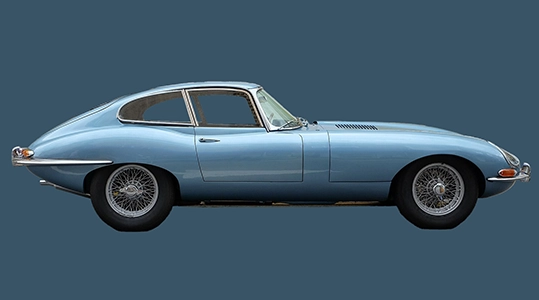
The Orpheus Record Garage is a guide to the collector cars that have achieved the highest publicly reported sale prices – not simply because they were rare, but because they carried the exact combination serious collectors search for: provenance, originality, competition history, ownership chain, specification, documentation, and timing.
At the top of the market, value is rarely created by marque alone. A Ferrari is not valuable simply because it is a Ferrari. A Mercedes-Benz is not historic simply because it wears a three-pointed star. The cars that define the market are the ones with stories that cannot be repeated.
A works racing history. A Le Mans victory. A single long-term owner. A factory team entry. A unique body. An untouched specification. A famous driver. A chassis number that changes everything.
These are the signals Orpheus Classic Car Alerts is built to understand.
Sold for approximately $143,000,000 – RM Sotheby’s, Stuttgart, 2022
The Mercedes-Benz 300 SLR Uhlenhaut Coupé is the collector-car market’s ultimate outlier: a car so rare, so important, and so long considered unobtainable that its sale rewrote the entire scale of automotive value.
Only two Uhlenhaut Coupés were built. They were developed from Mercedes-Benz’s post-war racing technology and named after Rudolf Uhlenhaut, the brilliant engineer behind the project. The car was conceived as a closed version of the 300 SLR racer, with roots in the same Silver Arrow lineage that produced Juan Manuel Fangio’s championship-winning machines. For decades, collectors assumed Mercedes-Benz would never sell one.
The example sold in 2022 was known as the “Red” car because of its interior. It had covered only a little over 6,000 kilometers and had been used by Uhlenhaut himself as a company car, later appearing at major historic events including Pebble Beach and Goodwood. Mercedes-Benz used proceeds from the sale to establish a charitable fund supporting education and research in environmental science and decarbonisation. Its $143 million result remains the benchmark against which every other public collector-car sale is measured.
Sold for $53,917,370 – RM Sotheby’s, Stuttgart, 20254
The W 196 R Stromlinienwagen is another Silver Arrow with a story that sits at the intersection of design, speed, scarcity, and institutional provenance.
Sold by the Indianapolis Motor Speedway Museum, chassis 00009/54 became the most expensive Grand Prix car ever sold when it achieved €51.155 million in 2025. It was one of only four complete streamliner-bodied W 196 R cars and the first of those to enter private ownership. Its history includes victory with Juan Manuel Fangio at the 1955 Buenos Aires Grand Prix and fastest lap at the Italian Grand Prix with Stirling Moss.
The result matters because it shows how museum provenance can transform market perception. This was not merely a rare Formula 1 car. It was a preserved piece of post-war engineering mythology, sold from one of the world’s major motorsport institutions to support the museum’s future expansion and restoration work.
Sold for $51,705,000 – Sotheby’s, New York, 2023
This Ferrari occupies a particularly interesting space in GTO history. Chassis 3765LM is often discussed as a 330 LM / 250 GTO, and its value comes from a expensive wristwatch ever sold publicly at the time.
That Scuderia Ferrari connection is the kind of provenance serious collectors prize above almost everything else. The car ran at the 1962 Nürburgring 1000 KM with Mike Parkes and Willy Mairesse, finishing second overall. It was then entered at Le Mans by SEFAC, Ferrari’s factory racing operation, before later being converted and campaigned by private owners.
Its $51.705 million result made it the most valuable Ferrari ever sold publicly at the time. It is a perfect Record Room car because its story demonstrates why reference, chassis, configuration, and racing history cannot be separated. To a casual observer, it is “a Ferrari.” To a serious collector, it is a factory-linked competition chassis with a layered identity and a documented place in the GTO universe.
Sold for $48,405,000 – RM Sotheby’s, Monterey, 2018
Before the Uhlenhaut Coupé changed the entire scale of the market, this Ferrari 250 GTO was the auction world’s defining collector-car sale.
Chassis 3413 GT was the third GTO built and the first to wear Series I Scaglietti coachwork. Its racing record is exceptional. It was intended for Phil Hill’s testing ahead of the Targa Florio, then went to Italian privateer Edoardo Lualdi-Gabardi, who won nine of ten national events in the car and became 1962 Italian GT Champion. Later owners included prominent collectors, and the car continued to appear in historic racing and concours settings.
What made the sale so powerful was not just the model name. It was the quality of the individual car: matching numbers, high originality, Classiche inspection, Marcel Massini’s endorsement, and a racing history that made the chassis more than a static object. This is exactly the kind of multi-layered signal Orpheus is designed to track.
Sold for $38,500,000 – Mecum, Kissimmee, 2026
Chassis 3729GT, known as Bianco Speciale, is one of the most distinctive Ferrari 250 GTOs because it was factory-finished in white – the only GTO delivered that way. That single specification detail gives the car a visual identity most GTOs do not have.
Originally commissioned by British entrant John Coombs, the car debuted at Brands Hatch in 1962 with Roy Salvadori, then continued racing at Goodwood and elsewhere. It later passed to British racer Jack Sears, who kept it for three decades, before joining the collection of Jon Shirley. At Mecum Kissimmee in 2026, it hammered at $35 million and reached $38.5 million with fees. oduction, nuanced terminology, and very fast-moving demand.
This result is especially useful for Orpheus because it proves how much value can sit inside one apparently small phrase: factory white. A general search might see another GTO. A collector sees a unique livery, a Coombs connection, a long-term ownership chain, and a saleable story.
Sold for $38,115,000 – Bonhams, Monterey, 2014
The 2014 Bonhams GTO sale was a landmark moment for the public auction market. Chassis 3851 GT was the 17th GTO built and had a hard, eventful racing life.
The car was ordered by French privateer Jo Schlesser and raced at the Tour de France Automobile, where Schlesser and Henri Oreiller finished second. Oreiller was later killed at Montlhéry, and Ferrari rebuilt the damaged car. It subsequently raced in Italian hillclimbs and continued through the hands of notable privateer owners, including Fabrizio Violati, founder of Ferrari Club Italia.
Its value rests partly in the fact that it was not a garage queen. It had lived the life a GTO was built for: racing, damage, repair, continued competition, and long-term enthusiast ownership. For many collectors, that kind of history is not a flaw. It is the reason the car matters.
Sold for $36,344,960 – RM Sotheby’s, Paris, 2025
The Ferrari 250 LM is one of the great endurance-racing machines, and chassis 5893 has one of the strongest stories of all. It was the sixth of only 32 examples built and won the 1965 24 Hours of Le Mans outright for Luigi Chinetti’s North American Racing Team, driven by Masten Gregory and Jochen Rindt.
That victory matters deeply. It remains the only privateer-entered Ferrari to win Le Mans outright, and it capped Ferrari’s run of six consecutive Le Mans victories. The car also competed in six 24-hour races – three times at Le Mans and three times at Daytona – before spending more than five decades in the Indianapolis Motor Speedway Museum.
Its 2025 result made it the most expensive Le Mans-winning car ever sold publicly. For Orpheus, this is the perfect example of why alert intelligence must understand race entries, museum ownership, chassis identity, and event history – not just model names.
Sold for $35,821,289 – Artcurial, Paris, 2016
The Ferrari 335 Sport Spider is a car defined by danger, speed, and glamour. Chassis 0674 began life as a 315 S, raced at Sebring, then went to the Mille Miglia, where Wolfgang von Trips finished second. The event was overshadowed by the tragic crash involving Alfonso de Portago, a moment that helped bring the Mille Miglia as an open-road race to an end.
The car was later converted to 335 Sport specification and entered at Le Mans with Mike Hawthorn and Luigi Musso. It also helped Ferrari secure the 1957 Constructors’ Championship and later won the Cuban Grand Prix with Stirling Moss and Masten Gregory. After passing through Luigi Chinetti’s hands, it entered Pierre Bardinon’s legendary Mas du Clos collection.
Its Artcurial sale showed the market’s appetite for cars with intense, complex histories. This was not a sterile collectible. It was a witness to one of the most dramatic periods in sports-car racing.
Sold for $30,255,000 – Bonhams, Monterey, 2023
The Ferrari 412P is one of the rarest competition Ferraris of the 1960s. Only four were built, and chassis 0854 is especially significant because it retained its original bodywork, driveline, and chassis.
It was delivered to Colonel Ronnie Hoare’s Maranello Concessionaires and campaigned by drivers including Richard Attwood, Piers Courage, Lucien Bianchi, Jo Siffert, and David Piper. Its racing life included Le Mans, the Paris 1000km, and the Swedish Grand Prix. The car later underwent a meticulous restoration in which its original alloy bodywork was refitted.
The sale is a reminder that originality can be as powerful as victory. The 412P did not need to be the most successful Ferrari prototype to become a major market event. It needed rarity, factory-linked competition history, and the right level of surviving material.
Sold for $29,650,095 – Bonhams, Goodwood, 2013
When this W196 sold in 2013, it became the most expensive car ever sold at auction at that time. Chassis 00006 was the open-wheel Silver Arrow that carried Juan Manuel Fangio to victory at the German Grand Prix and then won again in Switzerland.
Its importance lies in its direct connection to Formula 1’s early post-war mythology. It was the only surviving W196 to have won two championship-qualifying races and, crucially, it was the only one not retained by Daimler-Benz or a major museum when it came to sale.
That final detail is classic Orpheus territory. Availability can matter almost as much as rarity. When nearly every comparable car is permanently locked away, the one privately obtainable example becomes a market event.
Sold for $28,050,000 – RM Sotheby’s, New York, 2015
The Ferrari 290 MM was Enzo Ferrari’s answer to Mercedes-Benz dominance in the mid-1950s World Sportscar Championship. Built as a works prototype racer, it was driven by a remarkable cast that included Juan Manuel Fangio, Phil Hill, and Wolfgang von Trips.
Chassis 0626 competed in major events including the Mille Miglia, Nürburgring 1000km, and Swedish Grand Prix, contributing to Ferrari’s championship efforts. After its works career, it passed through Luigi Chinetti and eventually joined Pierre Bardinon’s Mas du Clos collection for decades.
This is the kind of car where the provenance stack is almost impossible to recreate: works Ferrari, major races, legendary drivers, long-term collector ownership, and a connection to one of the most revered Ferrari collections ever assembled.
Sold for $27,500,000 – RM Sotheby’s, Monterey, 2013
The 275 GTB/4 NART Spyder is a story of scarcity, taste, and American Ferrari history. Luigi Chinetti, Ferrari’s North American importer, persuaded Enzo Ferrari to build open versions of the 275 GTB/4 Berlinetta for the American market. Only ten were made.
This example belonged to Eddie Smith Sr., who kept it for decades despite repeated attempts from wealthy collectors and celebrities to buy it. Steve McQueen, who owned another NART Spyder, tried to purchase Smith’s car after his own was damaged, but Smith would not sell. After Smith Sr. died, his son consigned the car and donated the proceeds to charity in tribute to his father.
Its record price was not just about rarity. It was about emotional provenance: the right car, the right long-term owner, the right story, and a charitable sale that gave the auction a
