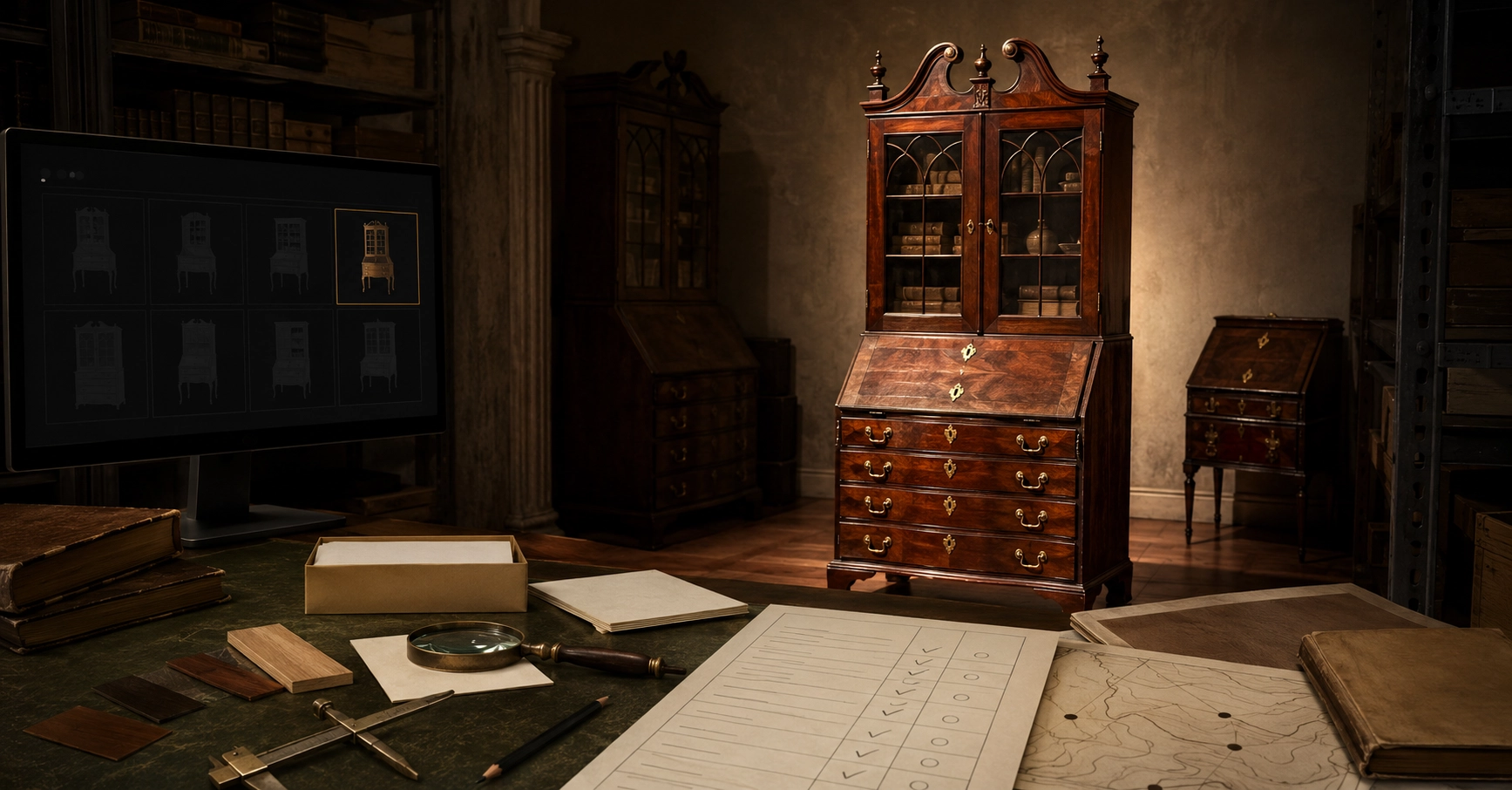
A rare object is rarely lost because nobody wanted it. It is lost because the right buyer learned about it too late. Knowing how to track rare antiques means building an information system that reaches beyond major auction calendars and dealer newsletters, into the fragmented channels where significant objects first appear.
For serious collectors, discovery is not a casual browsing exercise. A George II giltwood mirror may be cataloged as a “decorative wall mirror” by a regional auctioneer. A period American highboy may sit in an estate-sale listing with three incomplete photographs. An important piece of early Meissen may be offered under a family name rather than a factory attribution. The opportunity exists, but the signal is weak.
Mainstream search is designed to find what has already been indexed, described consistently, and promoted broadly. Rare antiques do not move through a single, orderly marketplace. They circulate through local auction houses, estate liquidations, probate sales, specialist dealers, private listings, smaller galleries, and regional platforms with uneven cataloging standards.
By the time an exceptional object appears in the familiar places, it may already have been identified by a dealer, advisor, or collector with better monitoring. For a buyer competing for scarce examples in English furniture, Continental ceramics, antique lighting, silver, folk art, or historical decorative arts, timing is not a convenience. It is part of the acquisition strategy.
The practical challenge is that antique descriptions are inconsistent. One cataloger may identify a “Regency brass-inlaid rosewood sofa table.” Another may simply write “antique table.” An estate representative may use a family term, a room description, or no useful term at all. Your tracking system must account for that uncertainty rather than depend on one precise phrase.
The strongest searches begin before any search is run. Define the object you want with enough specificity to reduce noise, but not so narrowly that you exclude the overlooked listing you hope to find.
Start with the core identity: maker, workshop, period, region, material, form, and approximate date. Then establish acceptable variations. If you are seeking an 18th-century English secretary bookcase, decide whether you would consider a bureau bookcase, secretaire, escritoire, or fall-front bookcase. If you are pursuing French Art Deco furniture, clarify whether unsigned work from a particular atelier or school belongs within your mandate.
A useful acquisition brief contains three layers:
This brief should reflect how you actually buy, not merely what you admire. A collector furnishing a Palm Beach residence may prioritize scale, finish, and immediate placement. A dealer may accept condition complexity where provenance, rarity, or margin supports restoration. An advisor sourcing for a client may require clean title, export clarity, and documented attribution. Each mandate creates a different tracking model.
Rare antiques are found through language variants. Track makers’ names with common misspellings, abbreviated names, former attributions, and family names. Track forms with regional terminology. Track materials with both technical and casual descriptors.
For example, a search for “tortoiseshell cabinet” may miss listings described as boulle, brass-inlaid, marquetry cabinet, or ebonized cabinet. A search for “Windsor chair” may miss comb-back, sack-back, bow-back, or simply painted country chair. The goal is not to generate a flood of irrelevant results. It is to anticipate the imperfect language of the market.
Photographs create another complication. A listing may include no meaningful text, yet show a period object that is immediately recognizable to an informed eye. That is why keyword alerts alone are insufficient for serious acquisition work. Strong tracking combines structured terms with human review, image assessment, and source-level intelligence.
The major houses matter, particularly for benchmark pricing, provenance, and top-tier material. But they are also the most visible venues. Competitive advantage often develops earlier, in the channels that receive less consistent scrutiny.
Regional auction houses can surface estate property before specialist marketing reframes it. Estate-sale operators may list objects quickly with limited research. Local galleries often acquire stock privately and publish it without broad announcement. Generalist marketplaces can hold miscataloged pieces among ordinary household contents.
The trade-off is clear: lower-visibility sources produce more noise, uncertain descriptions, and greater due diligence demands. Yet they also produce the most attractive asymmetry. A collector who can identify significance before a listing is polished and widely circulated can act while the field is still narrow.
Do not treat every source equally. Rank sources according to the categories they have historically handled, the quality of their photography, their tendency to undercatalog property, their geographic estate base, and their speed from intake to sale. A small house with regular consignments from established New England estates may deserve more attention for Federal furniture than a larger platform with broad but undifferentiated inventory.
The first public listing is not always the first signal. New inventory can appear as a sale preview, a partial catalog upload, a newly posted estate date, an uncaptioned image gallery, or a short social announcement. In fragmented markets, these early signals are often more valuable than the final polished description.
Track upcoming sales as well as currently available objects. Review newly added lots, not only search results sorted by relevance. Watch for consignor names, estate references, collection dispersals, and regional events associated with the type of property you seek. A sale described as “property from a Connecticut estate” may offer little at first glance, but it can justify early catalog review if the estate’s collecting history is known.
Speed should not mean haste. An alert is an invitation to investigate, not a substitute for judgment. The objective is to secure time for review while other buyers are still unaware of the object.
Once a lead appears, separate the discovery decision from the bidding decision. A promising listing can merit immediate attention without meriting an immediate offer.
First, assess identification. Are the form, construction, materials, ornament, and proportions consistent with the stated period or attribution? Ask for high-resolution photographs of backs, undersides, drawer construction, locks, hardware, labels, signatures, repairs, and areas of wear. For ceramics, request marks, foot rims, restoration under ultraviolet light when possible, and close images of decoration. For silver, examine hallmarks, maker’s marks, weight, and later alterations.
Then assess condition and economics. A rare object with old restorations may still be the correct acquisition. A more common object with a compromised surface may not be. Consider buyer’s premium, tax, crating, insurance, restoration, authentication, and the practical cost of moving the object into your collection. The right ceiling is rarely the published estimate.
Finally, establish provenance and legal clarity. Verify ownership representations, export restrictions, cultural-property considerations, and any claims attached to the piece. For high-value acquisitions, an independent specialist opinion may be prudent. Discovery creates access. Due diligence protects value.
Antique tracking fails when it relies on memory. Establish a review cadence that matches the pace of your category. Highly active fields may require daily alert review and weekly source checks. More specialized categories may benefit from a careful weekly review, paired with immediate assessment of high-confidence matches.
Maintain a private record of every serious lead: source, date found, listing language, images, estimate or asking price, condition notes, attribution questions, and outcome. Over time, this becomes a proprietary market file. You will recognize which sources consistently produce undervalued material, which phrases conceal quality, and which estimates invite competition.
This record also improves your brief. If alerts repeatedly surface near-matches that you reject, refine exclusions. If a maker appears under an unexpected catalog term, add it. Effective tracking is iterative intelligence work, not a static saved search.
Automation can scan far more sources than an individual collector can review manually. It can monitor newly published inventory, detect term variations, and surface emerging signals across dispersed marketplaces. Orpheus Alerts applies proprietary scanning technology to that fragmented landscape, delivering opportunities based on the collector’s defined acquisition criteria rather than broad marketplace promotion.
But technology should strengthen connoisseurship, not imitate it. A system can identify a possible match; it cannot fully resolve originality, condition, proportion, rarity, or whether an object belongs in your collection. The strongest position combines broad machine-led monitoring with disciplined human evaluation.
Rare antiques reward preparation. When the right object appears in an obscure catalog, a regional estate sale, or an imperfectly described listing, the collector with a clear brief, a trusted due-diligence process, and early intelligence has something more valuable than another search result: time to make the right decision.
