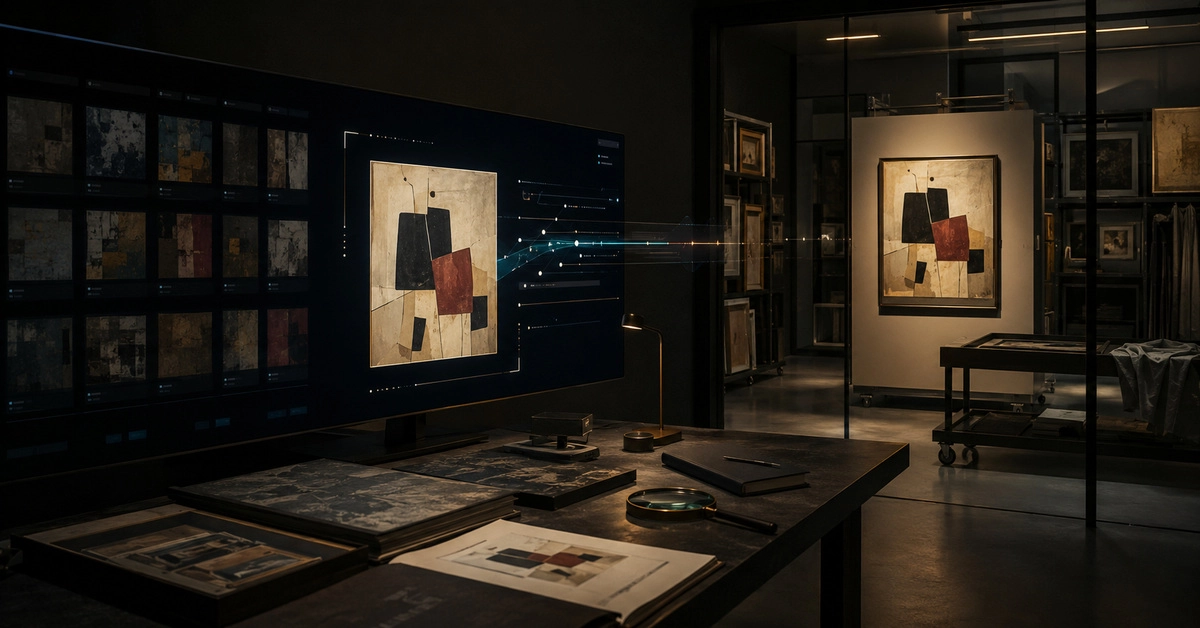
A major work can surface on a regional auction calendar, an estate-sale listing, or a lightly indexed dealer page and disappear before the wider market notices. That is the central fact shaping the future of art market intelligence: competitive advantage will belong less to the buyer with the loudest network and more to the buyer who sees credible opportunities first.
For serious collectors, intelligence is not a dashboard full of sales records. It is an early, relevant signal paired with enough context to decide whether immediate attention is warranted. In markets where a single overlooked listing can alter a collection, timing is not a convenience. It is part of the acquisition strategy.
The art market has no shortage of data. Major auction results are published, gallery inventory is promoted, and broad search engines can retrieve well-known names in seconds. But by the time an object is fully visible, correctly categorized, and widely circulated, the informational advantage may already be gone.
The harder problem is discovery across fragmented markets. A 19th-century bronze may be described by its subject rather than its sculptor. A significant design object may be buried inside a general household sale. A painting with an incomplete attribution may be listed under an imprecise title, a misspelled artist name, or no meaningful category at all.
Standard search works best when the buyer knows exactly where to look and the seller has described the object accurately. Serious acquisition rarely offers either condition. The future belongs to systems that can continuously examine new, uneven, and poorly indexed material, then recognize possible relevance before an opportunity becomes obvious.
This is a meaningful distinction. Data reports what has already been recognized and sold. Market intelligence identifies what may be becoming available now.
The most valuable intelligence often begins with a weak signal: a newly posted lot, an amended catalog description, a local listing with limited photography, or an estate-sale preview that has not yet reached specialist buyers. None of these signals is a purchase recommendation on its own. Each is an invitation to investigate before the crowd arrives.
Agentic AI changes the economics of that investigation. Rather than asking a collector to repeat the same searches across dozens of sources, a purpose-built system can monitor published inventory continuously against a defined acquisition brief. That brief may include a named artist, medium, period, movement, subject, dimensions, preferred condition, and price range.
The quality of the brief matters. A collector pursuing French Art Deco lighting needs a different intelligence model than an advisor sourcing early California plein air paintings or a dealer tracking postwar Italian ceramics. Broad notifications create noise. Narrow criteria create silence. Effective intelligence sits between the two, using related terminology, historical context, and market language to identify plausible matches without flooding the collector with irrelevant inventory.
That is why the next generation of art intelligence will be increasingly personal. The system should become more useful as it understands what the collector rejects, what they pursue, and where flexibility exists. A buyer may accept a smaller work by a sought-after artist, for example, but not an inferior condition report. Another may prefer a lesser-known maker from a particular workshop over a more commercial name. These preferences are not filters in the ordinary sense. They are acquisition judgment translated into a standing search mandate.
Earlier discovery creates an edge, but it also creates risk. A poorly photographed object may be misattributed. A catalog entry may omit restoration, provenance gaps, export restrictions, or a material defect. A price that appears favorable may reflect a buyer's premium, a difficult location, or an issue invisible in the first listing.
Intelligence should therefore compress the time from discovery to informed action, not eliminate scrutiny. The right response to an early alert is disciplined triage: assess the source, compare the object against known examples, request condition and provenance material, and establish the true all-in acquisition cost. Where the stakes justify it, consult the appropriate specialist.
This is where automated systems and human expertise have distinct roles. Technology is exceptionally effective at persistent monitoring, pattern matching, and bringing dispersed signals into view. It is not a substitute for connoisseurship, condition assessment, legal review, or the judgment required to place an object within a collection.
The strongest buyers will use both. They will let technology do the exhaustive watching, while reserving their own attention for questions that require experience: Is the attribution credible? Is the work characteristic? Does it strengthen the collection? Is this genuinely scarce, or merely presented as such?
Collectors often treat discretion as a matter of personal preference. In competitive acquisition, it is also strategic. Search behavior can reveal an emerging collecting focus, a new budget threshold, or a buyer's intention to assemble a group of works. When that information is captured, shared, or used to market inventory back to the collector, the intelligence relationship becomes compromised.
The future of art market intelligence will favor platforms that work solely for the subscriber. That means a collector's search criteria should not become a lead list for brokers, advertisers, or data resellers. It also means alerts should direct attention to opportunities without introducing unnecessary intermediary pressure.
For buyers active in tightly contested categories, from Upper East Side collections to Palm Beach estates and beyond, this distinction is practical. A private search mandate should produce private intelligence. The collector should retain control over whom to contact, when to pursue an object, and how much interest to reveal.
A platform that scans more sources but sends unusable results has shifted the work, not solved it. The central performance measure is not volume. It is relevance at the moment relevance is highest.
That requires proprietary scanning technology capable of handling inconsistent descriptions and emerging signals across fragmented marketplaces. It also requires restraint. Not every mention of an artist is a meaningful lead. Not every low estimate is an opportunity. Not every newly listed object deserves urgency.
Orpheus Alerts is built around that discipline: continuous discovery for collectors who want direct visibility into hard-to-access inventory, not a generic feed of already-promoted stock. The objective is simple and demanding: surface the right opportunity early enough for the subscriber to act on it.
There will always be occasions when conventional channels are best. A collector seeking a fully authenticated, museum-exhibited work with extensive published provenance may choose a major house or established gallery precisely because the process is more controlled. But when the objective is to locate scarce, overlooked, or newly surfaced material, broad visibility is often the enemy of value.
The collectors best positioned for what comes next will define their search with more precision than a single name or category. They will specify what matters most, where compromise is acceptable, and what should trigger immediate review. A strong mandate captures the object sought, but also the collector's standards.
Start with the non-negotiables: artist or category, period, medium, price range, geography, and condition threshold. Then add the signals a conventional search may miss, such as alternate names, workshop associations, subject matter, related makers, old collection labels, or regional terms. Finally, decide what an actionable alert means. It may be a complete match, a credible attribution requiring rapid inquiry, or an adjacent work that merits a specialist's attention.
The art market will not become less fragmented. If anything, inventory will continue to appear across more channels, in more inconsistent forms, and at greater speed. The collector's task is not to watch everything. It is to establish a private intelligence capability that watches intelligently, preserves discretion, and makes the next important opportunity visible before it becomes public knowledge.
