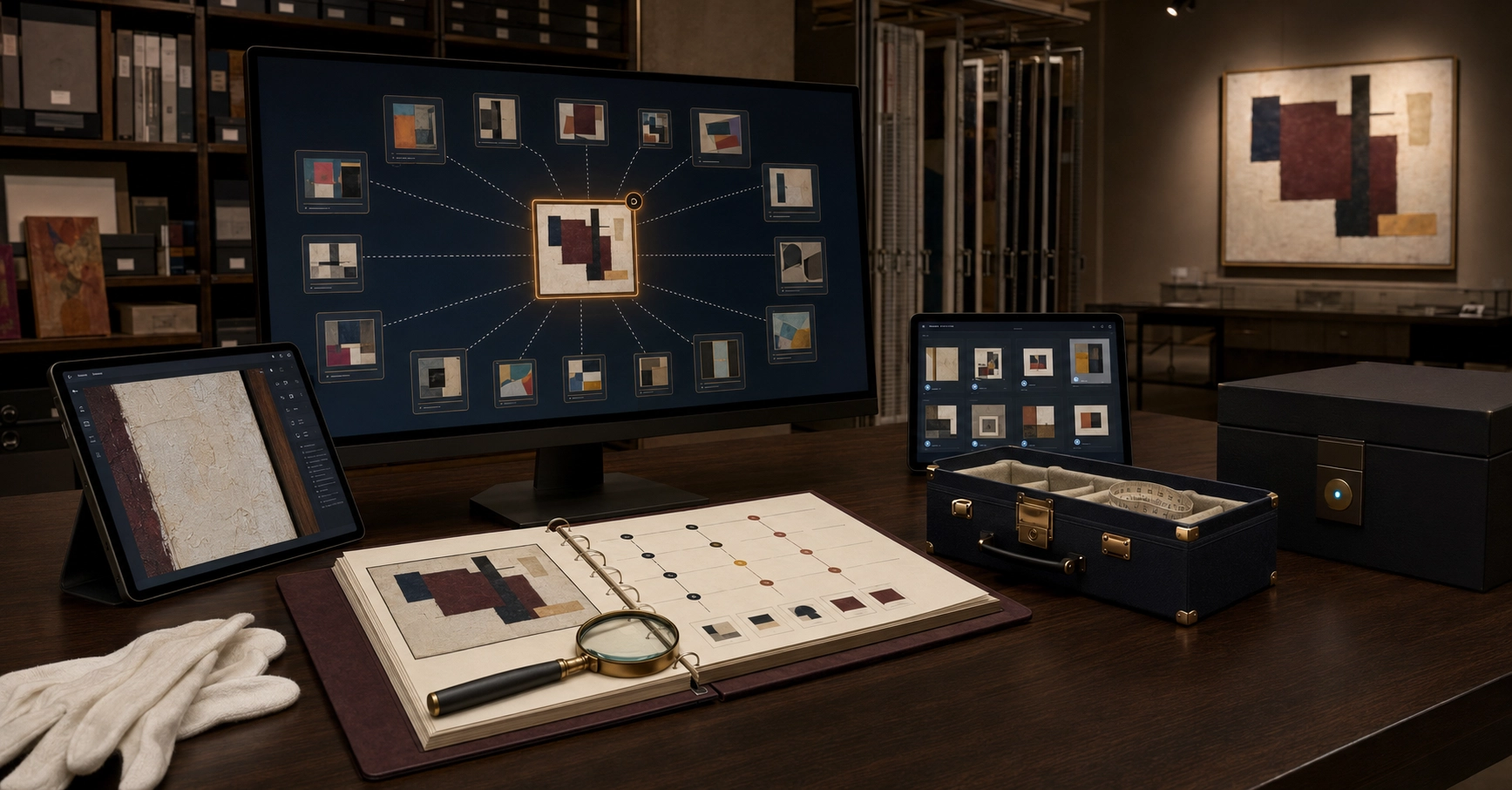
A work you have pursued for years rarely arrives through a polished, widely circulated listing. It appears in a regional auction catalog, an estate-sale upload, a gallery inventory update, or a poorly indexed local marketplace - and it may be gone before a conventional search ever finds it. The best tools for art collectors are therefore not simply databases or inventory apps. They are an intelligence system built to improve discovery, judgment, and execution.
For serious buyers, the question is not which single platform does everything. No platform does. The question is which tools reduce the most expensive forms of friction: seeing an object too late, misreading its context, or losing the documentation that protects its value after purchase.
A disciplined collecting operation needs to identify emerging opportunities, assess them quickly, and maintain a reliable record once an acquisition is made. These functions require different tools because the art market remains fragmented by design. Inventory is distributed across major auction houses, specialist dealers, estate liquidators, regional salerooms, private listings, and galleries whose online catalogs may be incomplete.
The practical error is relying on a single familiar auction site or a standard search engine as if it represents the market. Those sources are useful for broad market awareness and price context, but they tend to surface inventory after it has already become visible to competing buyers. They are reference tools, not an early-warning system.
A stronger approach is to build a compact stack around the following functions: market monitoring, research and provenance, condition and logistics, collection management, and secure records.
The highest-leverage tool is a standing alert system that monitors the places where opportunities first emerge. It should be able to track named artists, periods, media, makers, subject matter, dimensions, price parameters, and the language sellers use inconsistently.
This last point matters. A bronze may be cataloged under an artist's name, a foundry, a school, a collection, or simply as "unsigned sculpture." A work on paper may be listed with a misspelled attribution, an obsolete title, or only a descriptive phrase. Exact-match search is inadequate when terminology is unstable and catalogs vary widely in quality.
An effective monitoring tool needs to interpret the collecting brief rather than merely repeat keywords. It should also prioritize newly published signals. A late alert may still be interesting; an early alert creates options. You can request additional images, inspect the lot, commission research, and decide whether the object merits action before a broader audience arrives.
Orpheus Alerts is designed around this advantage: proprietary scanning technology continuously monitors fragmented and poorly indexed sources, then delivers targeted alerts tied to a collector's specific acquisition criteria. The distinction is simple. Standard search helps you browse what is already obvious. Collector intelligence helps you detect what is becoming available.
Alerts are only as good as the instructions behind them. Avoid a vague request such as "French modern art" if the actual mandate is works on paper by a defined group of artists, dated before 1940, under a specified size and budget.
A useful brief includes the artist or category, preferred and excluded media, date range, dimensions, price ceiling, geographic flexibility, and acceptable attribution language. It should also identify substitutes. If a particular artist is scarce, are works by documented pupils, a related atelier, or a comparable regional school worth seeing? Precision limits noise. Carefully chosen flexibility prevents missed opportunities.
Once an object surfaces, price databases and auction archives help establish context. Their role is not to tell you what a work is worth with false precision. Their role is to show how comparable works have been described, sized, dated, condition-reported, and sold over time.
Look beyond the headline result. Was the comparable sold in a major evening sale or a lightly attended regional auction? Did it have distinguished provenance? Was it authenticated, restored, editioned, mounted, framed, or accompanied by literature? A high result for an exceptional example can be a poor benchmark for a compromised work.
For unique works, comparison requires judgment rather than an average. For editioned prints, sculpture, and design objects, edition size, edition number, casting date, manufacturer, finish, and posthumous status may materially change value. Historical sales data is most useful when paired with catalog-reading discipline.
Use research tools to answer a focused set of questions: What has actually traded? How frequently does this category appear? Which descriptions recur? Where does the price range widen, and why? That is more valuable than treating a database estimate as a buying instruction.
The most elegant listing can conceal the most costly uncertainty. Before bidding or transferring funds, create a due-diligence file that separates what is documented from what is merely asserted.
Start with provenance. Establish a chronology of ownership as far as the available evidence supports it, and flag gaps without assuming they are disqualifying. Many legitimate objects have incomplete histories. The issue is whether the account is coherent for the object, period, and seller, and whether supporting materials withstand inspection.
Then review catalogues raisonnés, foundation records where available, exhibition histories, literature references, prior catalog entries, and relevant expert opinions. These sources serve different purposes. Inclusion in a catalogue raisonné can be highly significant, but it does not eliminate the need to examine condition, title, date, medium, dimensions, and any later changes to attribution.
Keep original invoices, reports, correspondence, export documents, and high-resolution images in the same file. A verbal assurance is not a record. If a work is later insured, consigned, donated, or passed to heirs, the strength of its documentation will matter as much as the story surrounding it.
Collectors sometimes treat condition reports as a procedural detail. At the upper end of the market, they are part of the investment thesis. A work with stable age-appropriate wear may be entirely acceptable. A work with structural instability, concealed repair, active corrosion, mold exposure, lifting paint, or poor restoration may demand a different price or a decision to walk away.
Request detailed images under raking light when appropriate, images of signatures and inscriptions, verso photographs, frame or base details, and clear dimensions. For material acquisitions, especially paintings, sculpture, furniture, and works on paper, an independent conservator can be more valuable than another round of pricing analysis.
Logistics should enter the decision before the bid, not after it. Confirm packing standards, crating, transit insurance, climate requirements, customs exposure, and delivery access. A large sculpture destined for a residence in Aspen or a delicate work on paper traveling to Palm Beach has practical risks that can alter the real acquisition cost.
After the purchase, a collection management system becomes the collector's institutional memory. It should hold images, invoices, provenance, condition reports, locations, insurance values, conservation history, loan records, and notes on future disposition.
The right tool depends on collection complexity. A focused private collection may need a disciplined digital archive with consistent naming conventions and controlled access. A collection spread across multiple residences, storage facilities, advisors, and entities may require formal collection-management software with permissions, location tracking, reporting, and insurer-ready documentation.
The non-negotiable principle is ownership of your data. Your acquisition history, target list, valuations, and locations are sensitive intelligence. Choose systems with clear privacy practices, exportable records, and access controls appropriate to the value of the collection. Convenience is not a sufficient reason to surrender control of a detailed acquisition profile.
Do not buy software because it promises a dashboard. Choose tools according to where your current process fails. If you keep missing objects, invest first in discovery intelligence. If you see enough inventory but struggle to separate strong examples from weak ones, strengthen your research and condition workflow. If the collection has grown faster than its documentation, organize the archive before another major purchase compounds the problem.
The best systems are not necessarily elaborate. They are responsive, discreet, and aligned with how you acquire. A collector pursuing one exceptional work each year needs deep monitoring and rigorous diligence. A dealer or advisor handling recurring acquisitions may need broader scanning, rapid triage, shared records, and clear decision authority.
The market does not reward the collector with the most tabs open. It rewards the collector who sees the right signal early, knows what to ask next, and has the records to act with conviction.
