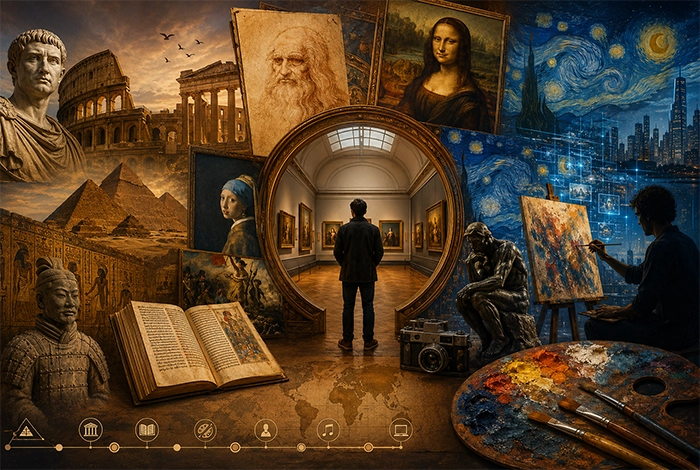
Throughout history, armies have conquered nations, governments have risen and fallen, fortunes have been made and lost, and technologies have transformed civilizations. Yet, when historians look back across centuries, it is often a work of art—a painting, sculpture, building, manuscript, or piece of music—that best captures the spirit of an age.
Art is not simply decoration. At its highest level, it preserves ideas, challenges assumptions, inspires revolutions, comforts the suffering, records history, and shapes the identity of entire cultures. While political leaders may influence a generation, great works of art often influence many generations.
Before photography, film, and digital media, artists were society's visual historians. They documented rulers, battles, religious beliefs, scientific discoveries, and daily life. Much of what we know about ancient Egypt, Greece, Rome, Renaissance Italy, Imperial China, or medieval Europe comes not from written records alone, but from the surviving art created during those periods.
Every civilization leaves behind two legacies. One is what it built. The other is what it created.
Centuries later, it is often the art that continues speaking.
Some works of art have quietly altered the course of history by changing how people think.
The Renaissance did not begin because of a single political decision. It emerged from thousands of artists, architects, scholars, and patrons rediscovering classical knowledge and celebrating human potential. Their paintings and sculptures reflected new ways of seeing the world, helping shape an intellectual movement that transformed Europe.
Likewise, the Impressionists challenged traditional ideas about painting. At first ridiculed by critics, their innovations eventually changed artistic standards around the world.
History repeatedly demonstrates that new artistic ideas often encounter resistance before becoming accepted.
Periods of war have produced some of history's most powerful artistic achievements.
Artists have documented destruction, celebrated courage, mourned loss, and warned future generations about the consequences of violence. Their work often survives long after eyewitnesses are gone.
These works remind us that statistics describe wars, but art reveals their human cost.
Throughout history, artists have frequently challenged authority.
Sometimes they have criticized injustice openly. At other times they have hidden their messages within symbolism that only informed viewers could recognize.
Authoritarian governments have often understood the influence of artists. Censorship, confiscation, and destruction of artworks have occurred in many countries because those in power recognized that ideas expressed visually can spread beyond speeches and official publications.
Destroying art has rarely erased the ideas behind it.
Many of history's greatest artistic achievements would never have existed without collectors, patrons, and institutions willing to support creative work.
Private collectors have preserved masterpieces through wars, economic crises, and political upheaval. Museums have made these works accessible to the public. Universities have studied them. Families have protected them for generations.
Collectors do far more than acquire objects.
They preserve cultural memory.
Every carefully assembled collection reflects personal judgment about what deserves to survive.
Modern technology allows almost anyone to view high-resolution images of famous paintings within seconds. Artificial intelligence can generate convincing images in moments. Digital reproductions have become remarkably accurate.
Yet millions of people continue to travel across continents to stand before original works.
Why?
Because an original artwork possesses qualities that cannot be completely reproduced. Scale, texture, craftsmanship, historical presence, provenance, and the knowledge that the artist once stood before that very canvas create an experience beyond the image itself.
Collectors understand this instinctively.
Originality remains valuable precisely because it is scarce.
One way to judge a civilization is not simply by its wealth or military power, but by what it creates.
Many ancient empires once dominated large parts of the world. Today, few people remember the names of many of their rulers.
Their art survives.
The sculptures remain.
The architecture remains.
The manuscripts remain.
The paintings remain.
Art often becomes the most enduring ambassador of a civilization.
Today humanity is creating more visual content than at any previous time in history. Billions of images are produced each year.
Paradoxically, this abundance increases the value of exceptional work.
When everyone can create images, originality, craftsmanship, authenticity, and cultural significance become even more important.
Future generations will not remember every image produced by artificial intelligence.
They will remember the works that captured something uniquely human.
The next great masterpiece may already exist in a private collection. It may hang in a museum, remain in an artist's studio, or wait to be rediscovered in an estate.
History suggests that important works often spend years—or even decades—before receiving the recognition they deserve.
For collectors, scholars, museums, and passionate enthusiasts, the search for significant art never truly ends.
Every generation rediscovers forgotten artists, re-evaluates overlooked masterpieces, and uncovers remarkable works that reshape our understanding of history.
That search is one of the great adventures of collecting.
