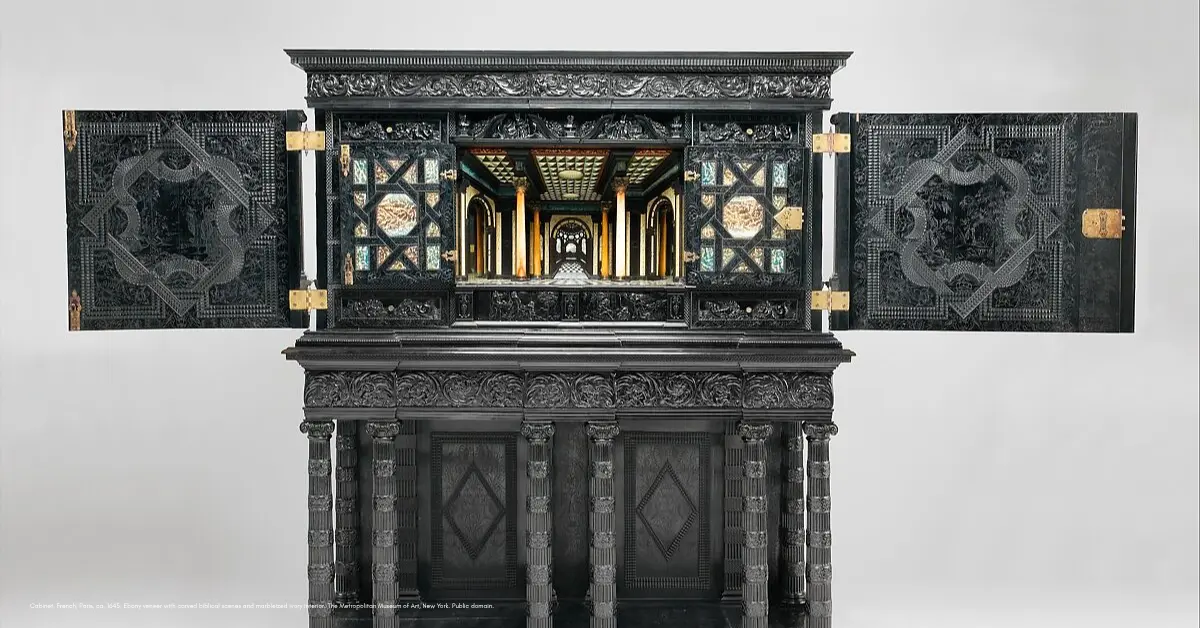
A chest of drawers came up at a provincial English auction in the early 1990s with an estimate of a few hundred pounds. It was a handsome piece but not one that stopped the room. When the auctioneer opened a side drawer to show its dovetailing to a prospective buyer, he noticed a paper label pasted to the inside of the carcass. The label read: Thomas Chippendale, Cabinet Maker, St Martin's Lane, London.
The piece did not sell for a few hundred pounds.
This is the central fact about cabinetmaker's marks: they are small, they are often hidden, and their effect on value can be extraordinary. For anyone buying antique furniture seriously, learning to find and interpret these marks is as important as understanding the wood, the construction, or the period.
A cabinetmaker's mark is any identifying stamp, label, brand, or inscription applied to a piece of furniture by its maker. The form varies considerably by country, period, and individual craftsman. English makers in the eighteenth century typically used printed paper trade labels, pasted inside drawers or on the back of case pieces. French ebenistes working under the guild system were legally required to strike a metal stamp into the wood of every piece they made. American colonial craftsmen sometimes signed their work in chalk on the back of a drawer, in pencil inside a carcass, or in some cases not at all.
The mark serves two functions that pull in slightly different directions. For the original maker, it was advertising: a label inside a chest of drawers was a quiet reminder, every time that drawer was opened, of who had made it and where they could be found. For the collector today, it is evidence -- proof of attribution that turns a handsome piece of furniture into a documented work by a known hand.
These are different things, and the difference matters. A label proves that a maker supplied or sold a piece. It does not always prove that every component was made in his workshop. A French guild stamp proves that a master accepted responsibility for a piece under the law of his trade. It does not prove that he personally worked the wood. The mark is the beginning of an attribution, not its conclusion. What the collector is really looking for is a mark supported by everything else the piece tells them.
The English paper trade label is among the most evocative objects in the furniture world. Printers produced them in small runs for individual craftsmen, and the makers pasted them inside case furniture as a matter of routine. Most have not survived: paper deteriorates, furniture is cleaned, labels fall away or are removed over two and a half centuries of use. The ones that remain are correspondingly rare, and their scarcity is part of what drives their value.
Thomas Chippendale is the name most collectors know. His label is among the most sought-after in any decorative arts category. Chippendale worked from a large workshop at 60-62 St Martin's Lane in London from the 1750s until his death in 1779. His 1754 pattern book, The Gentleman and Cabinet-Maker's Director, made his designs available to craftsmen across Britain and the colonies, which is both why his name is so well known and why attribution is complicated: thousands of pieces were made in the Chippendale style by other makers who had bought or copied his designs.
A piece with a documented Chippendale label is worth a very different sum from a piece in the Chippendale style. The difference can be measured in multiples of ten or more. A chest of drawers in good Chippendale taste, solidly made and in good condition, might sell for several thousand pounds at a regional auction. A chest with a confirmed Chippendale label and clear provenance becomes a candidate for a major London or New York sale.
Other English makers whose labels command serious premiums include Gillows of Lancaster, who stamped their work and whose records survive at the Lancaster Museum, allowing individual pieces to be traced back to specific commissions; George Seddon, who ran one of the largest cabinet-making operations in eighteenth-century London; and John Linnell, whose documented pieces appear regularly in significant sales. Each of these names carries weight because the records exist to support the attribution. The mark points to the maker; the maker's history gives the mark its meaning.
French furniture operates under a different and in some ways more reliable system. From 1743, French guild regulations required that every maitre ebeniste -- a master cabinetmaker admitted to the guild -- strike his initials and trade mark into the wood of each piece he made or sold. This stamp, called the estampille, was applied with a metal die and is usually found on a concealed surface: the underside of a marble top, the inside edge of a drawer opening, the back of a carcass.
The system creates a body of documented evidence unlike anything available for English or American furniture. A French piece with a clear estampille can often be attributed with confidence to a specific maker and, in some cases, to a specific royal or aristocratic commission when combined with surviving inventories and accounts. The paper trail for the finest French pieces of the Louis XV and Louis XVI periods is extraordinarily rich.
The stamps most likely to transform value include those of Bernard van Risenburgh, known as BVRB, who worked for the French crown in the mid-eighteenth century and whose pieces are among the most valuable French furniture in existence. Jean-Henri Riesener made furniture for Marie Antoinette and Louis XVI; his stamps appear on some of the finest pieces in museum collections worldwide. David Roentgen, German-born but working for the French court, produced mechanical furniture of such ingenuity that his pieces now belong in a category of their own.
A piece bearing the stamp of any of these makers is not simply furniture. It is a document of a moment in European material culture, and the market treats it accordingly. The gap between a fine unmarked piece in the Louis XVI manner and a documented piece by Riesener is not a matter of style or quality alone. It is a matter of history.
American colonial and federal furniture presents a different challenge. There was no guild system in the colonies, no legal requirement to mark work, and the craftsmen who made the finest American furniture of the eighteenth century were not always those who left the clearest paper trail. Attribution in American furniture relies heavily on regional characteristics: specific constructional techniques, wood choices, proportions, and decorative details that allow specialists to assign pieces to a shop, a city, or a family of craftsmen even without a mark.
The Goddard and Townsend families of Newport, Rhode Island, are the most celebrated example. Over several generations, these two interconnected families produced case furniture of extraordinary quality, including the block-and-shell carved pieces that have achieved the highest prices ever paid for American furniture. A signed or documented Goddard-Townsend piece is a major rarity. A piece attributed to their shops on the basis of construction and style can still reach very significant prices, but the difference between attributed and documented is real and measurable.
Philadelphia, Boston, and New York each produced furniture with characteristic features, and specialists can often identify a city of origin from construction details alone. A paper label, a chalk signature inside a drawer, or a bill of sale linking a piece to a named maker pushes prices substantially higher and transforms what might otherwise be an interesting regional piece into something that museums compete for.
Many marks are not immediately visible. A paper label inside a drawer may be hidden beneath later lining paper added during a Victorian refurbishment. A French estampille may be under a marble top that has not been lifted in decades. A chalk inscription may be on the back of a drawer that slides out completely and has not been fully removed in years.
Examining a piece of furniture thoroughly means removing every drawer and inspecting every surface. It means lifting detachable tops, looking at the inside of every door, checking the underside of every shelf and the back of every carcass. Ultraviolet light can reveal inscriptions and labels not visible in ordinary light. Raking light -- a strong source held at a shallow angle to a surface -- can make stamped marks legible that are too faint or shallow to read under direct illumination.
This examination is also where condition becomes apparent. A piece that has been heavily restored, refinished, or altered may have lost its mark in the process. Stripping and repolishing often destroys paper labels and can obscure stamped marks. A piece in original surface condition is more likely to have retained whatever evidence of its maker it originally carried, which is one of the reasons the market increasingly values original surface over a perfect restoration.
Where there is value, there is incentive to create false evidence, and the history of furniture collecting includes a long chapter on forged marks. The problem is not new: by the late nineteenth century, when enthusiasm for eighteenth-century French furniture had driven prices to levels that made forgery profitable, fakers were already at work. Some applied genuine estampilles removed from damaged pieces to finer ones. Some had new dies cut that closely resembled the marks of famous makers. Some simply added marks to pieces that were of the right period but had lost their original stamps.
English labels present similar challenges. A printed Chippendale label can be reproduced, and period paper is not difficult to obtain. A label on a piece should be examined under magnification and, in significant cases, by a specialist. The paper, ink, and printing method all provide evidence that can be assessed against known genuine examples.
The most important check against a suspicious mark is consistency between the mark and the piece. A genuine Chippendale label should appear on a piece constructed in the way Chippendale's workshop constructed furniture: specific secondary woods, specific methods of drawer construction, specific proportions and decorative details documented in the pattern book and in pieces with secure provenance. A label that sits on a piece that does not support the attribution raises immediate questions, however convincing the label itself appears.
Not every significant mark belongs to a famous name. Some of the most interesting furniture to come to market in recent years has been by regional makers whose documentation is less well known but whose quality is not in doubt.
Gillows of Lancaster is the strongest example. The firm stamped its work from the late eighteenth century and supplied furniture to households across the north of England and beyond. Gillows pieces appear regularly at regional auctions, sometimes without being recognized as such, and the firm's records -- unusually complete for any furniture maker of this period -- allow individual pieces to be traced back to specific orders, customers, and dates. A stamped and documented Gillows piece is not a Chippendale, but it is historically grounded in a way that many more glamorous attributions are not.
American regional makers offer similar opportunities for collectors who are prepared to do their research. The cabinetmakers of Salem, Massachusetts, the craftsmen working in the German tradition in Pennsylvania, the makers of the distinctive painted furniture of the Connecticut River Valley -- all of these have been studied, and pieces that can be placed within these traditions carry premiums that reflect the depth of scholarship behind them.
The principle applies broadly: a mark is most valuable when it connects a piece to a tradition that can be documented and examined. The famous names command famous prices, but the lesser-known makers, properly understood, offer the same logic at a different scale.
No mark exists in isolation. The three things that determine what a marked piece of furniture is worth are the mark itself, the condition of the piece, and its provenance -- meaning the record of who has owned it and where it has been.
Condition affects marked pieces as it affects all furniture, but with particular force at the top of the market. A Chippendale label on a piece that has been extensively restored, had new brasses fitted, and been stripped and refinished is a less compelling object than a label on a piece that retains its original surface, its original hardware, and its original evidence of use. The label authenticates the attribution; the condition determines what that attribution is worth in practice.
Provenance can reinforce or complicate a mark. A piece with a label that has been in the same family since the eighteenth century, documented in household inventories and estate records, is a very different proposition from an identical piece with the same label that appeared at auction in the 1970s without any earlier history. Both pieces may be genuine. But the one with the continuous history is the one that commands confidence, and confidence is what serious collectors pay for.
The supply of genuinely marked furniture is smaller than the demand for it, and it comes from a relatively small number of sources. Country house sales remain the most productive single category: furniture that has been in the same house for generations is furniture that has not been through the trade repeatedly, has not been restored to improve its saleability, and has not had its marks interfered with. Estate sales in England, France, and the northeastern United States have produced some of the most important attributed pieces of recent decades.
Regional auction houses are the second major source. The provincial English auction where a Chippendale label is noticed for the first time is not a fiction: it happens, though less often than it once did. Specialist knowledge has spread, auction house researchers are better trained than they were thirty years ago, and the internet has made it easier to check attributions before a sale. But gaps remain, and they remain most commonly in smaller houses where the volume of material is too high for every piece to receive the attention it deserves.
The dealer network is the third source, and in many ways the most reliable. Specialists in English furniture, French ebenisterie, and American antiques have spent careers learning what the marks look like, what the pieces look like, and how the two relate. Buying from a specialist dealer does not guarantee authenticity, but it does mean the piece has been looked at by someone whose professional reputation depends on getting such things right. The premium paid to a specialist dealer is partly the cost of that expertise.
The practical implication of everything above is a checklist that applies whether someone is looking at a piece in a country house sale, a regional auction, or a dealer's showroom. Look inside every drawer. Remove every drawer completely. Look at the back of every piece. Look under every top that can be safely lifted. Use a torch and, if possible, a magnifying glass on any surface that might carry a mark.
When a mark is found, the next step is research. The marks of most significant English makers have been catalogued. The estampilles of French guild masters are documented. American signed pieces have been studied by regional specialists whose work is published and accessible. Comparing what is on the piece with what is known about how the mark should look, and how the piece should be constructed, is not a guarantee but it is the best available tool.
For any significant purchase, specialist opinion matters. A furniture historian, a specialist at a major auction house, or an experienced dealer can often give an opinion quickly and at reasonable cost. For a piece where the mark is the primary claim to value, that opinion is not an optional extra. It is part of what the purchase requires.
The cabinetmaker's mark is an object lesson in how knowledge concentrates value. A piece of furniture and an identical piece of furniture with a documented mark are not the same object. One is a beautiful thing. The other is a historical document and a beautiful thing, and the market has always been prepared to pay for the difference.
About Orpheus Alerts
Orpheus Alerts monitors auction houses, private dealers, estate sales, and specialist networks worldwide to find important objects before they reach the open market. When you know what you're looking for, Orpheus finds it first. Explore Orpheus Alerts.
